

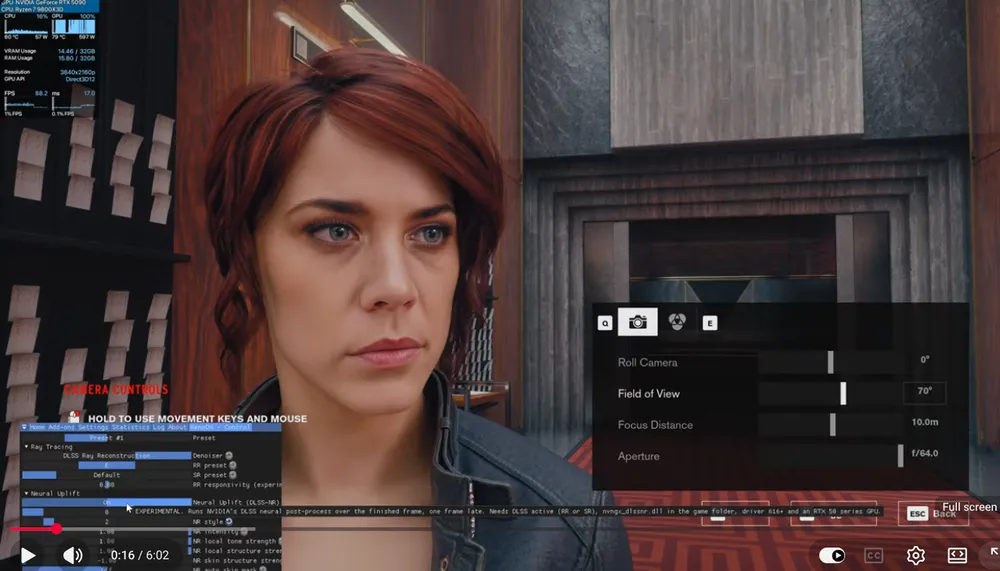
Nvidia's DLSS 5 is still officially unreleased, but modders are already experimenting with the technology in existing PC games, just one day before its official launch. With DLSS 5 set to debut in NBA 2K27, these early experiments are arriving at a pretty interesting time.
The experiments started after a previously unseen Nvidia library was discovered in the early-access version of NBA 2K27. The file, called nvngx_dlssnr.dll, appears to be linked to Nvidia's DLSS Neural Rendering technology.
It didn't take long for modders to put the discovery to use. Members of the RenoDX modding community managed to get the leaked library running in Control, giving players an early look at what the technology can do outside an official Nvidia implementation.
DLSS 5 is already being tested in Control
The experimental Control mod uses Neural Rendering on character models. It also includes several settings that let users change how the effect looks.
Early footage shows noticeable changes to details such as skin, hair and lighting. The results can look impressive, although they can also look quite different from the original game's art style.
And this isn't just a concept or a tech demo. Modders have actually managed to get the leaked technology running in the game and are now testing it in different situations.
The performance hit is significant
The early tests also highlight one obvious problem: Neural Rendering can be very demanding.
One test with an RTX 5070 Ti running Control at 4K reportedly saw performance drop from around 71 FPS to 35 FPS after the experimental Neural Rendering effect was enabled.
Those numbers shouldn't be taken as official DLSS 5 performance figures, though. The test uses a leaked library running through a community-made mod, rather than a finished Nvidia implementation.
Another modder has since modified the leaked DLL to run on an RTX 4090. In that test, Control reportedly dropped from around 130 FPS to roughly 82 FPS with the experimental technology enabled.
That's particularly interesting because Nvidia has positioned DLSS 5 as a technology for GeForce RTX 50-series GPUs. The RTX 4090 test doesn't mean Nvidia will officially support older cards, but it does show that the leaked software can be made to run on previous-generation hardware.
Modders are trying it in other games too
Control isn't the only game being used for these experiments. Modders have also been testing the leaked Neural Rendering technology in games such as Skyrim, Cyberpunk 2077 and Grand Theft Auto V.
The results vary from game to game. Some experiments change character details, lighting and materials, while others have highlighted just how much performance the current implementation can use.
That makes these tests interesting as an early glimpse at the technology, but they shouldn't be confused with the finished version of DLSS 5.
For Nvidia, the real test will come once DLSS 5 is officially available in supported games. Until then, these mods are mainly useful for showing what the technology might be capable of when developers get access to the proper tools.
This isn't the final version of DLSS 5
Nvidia officially announced DLSS 5 in March, describing it as a real-time Neural Rendering system that uses AI to enhance lighting, materials and other visual details while still working with the game's underlying content. The company has said the technology is coming later this year.
The version being tested by modders is therefore more of an unofficial preview than a finished product. Nvidia's final implementation could look different, perform differently and give developers much more control over how the technology is used.
Still, it's pretty unusual to see a major graphics technology being experimented with in games before its official release. For now, DLSS 5 has gone from something Nvidia showed off in presentations to something modders are already trying to bring into a growing number of PC games.
Source: NVIDIA – DLSS 5
Watch DLSS 5 in action

This YouTube video is privacy-friendly by default. YouTube content is only loaded when you press play.

Webmastahhh is the creator of Mastanet, a gaming and technology website where he shares news, reviews, guides and personal insights about games, hardware, software and the future of digital entertainment.