


Ray tracing can make games look more realistic, but it also puts extra pressure on graphics cards. Microsoft wants to make the technology more efficient with two new DirectX features that could significantly reduce the memory needed for ray tracing.
In a recent demonstration, Microsoft managed to reduce memory usage for ray tracing acceleration structures by almost 90%. The test also showed a major performance improvement, although the results come from a technical demonstration rather than a finished game.
The new features are called Clustered Geometry and Partitioned Top-Level Acceleration Structures. Both are designed to help developers handle complex game environments without having to rebuild large amounts of data whenever something changes.
Microsoft Introduces Two New DirectX Ray Tracing Features
Ray tracing requires a graphics card to keep track of objects and their geometry when calculating reflections, shadows and lighting. This information is stored in structures that can become expensive to build and update, especially in games with detailed environments and moving objects.
Microsoft's new features aim to make that process more efficient. Developers can use them separately or combine them, depending on how their games handle geometry and scene updates.
Clustered Geometry Breaks Complex Models Into Smaller Groups
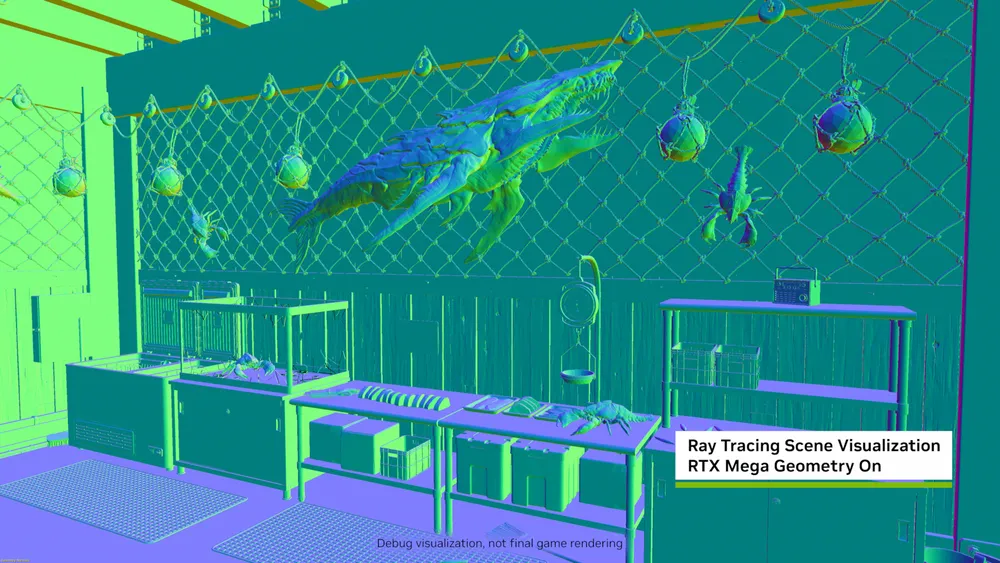
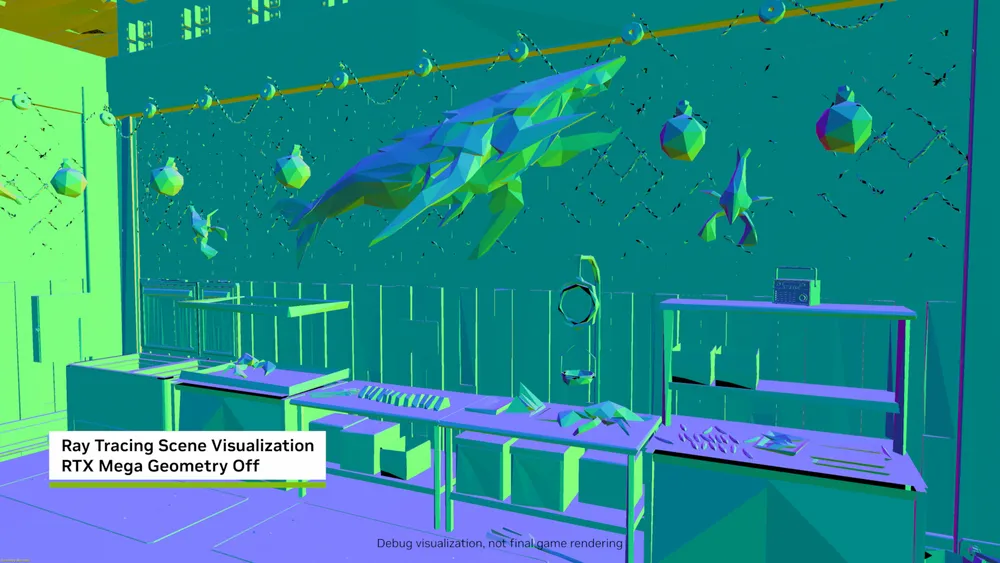
Clustered Geometry divides detailed 3D models into smaller groups called clusters. Each cluster can contain up to 256 triangles and vertices.
This gives developers more control over how geometry is handled. Instead of repeatedly processing large structures, they can work with smaller groups of data. This could be particularly useful for detailed environments, animated characters and objects that change during gameplay.
Partitioned TLAS Updates Only the Parts That Change
Partitioned Top-Level Acceleration Structures, or PTLAS, takes a different approach. Large game worlds often contain thousands of objects, but only some of them move or change during gameplay.
With PTLAS, developers can divide the scene into smaller regions and focus updates on the parts that have actually changed. Unchanged areas do not need to be processed again unnecessarily.
Microsoft Demonstrates Nearly 90% Lower Memory Usage
Microsoft tested Clustered Geometry on an AMD Radeon RX 9070, with some impressive results. Memory usage for the finished ray tracing acceleration structures dropped from 7,519 MiB to just 774 MiB.
Traditional Method
7,519 MiB
Memory used by acceleration structures.
Clustered Geometry
774 MiB
Memory used by acceleration structures.
That's a reduction of approximately 89.7%. The same demonstration showed performance increasing from 1.2 FPS to 79 FPS. The time needed to prepare and build the GPU acceleration structures also dropped from 788 milliseconds to 3.11 milliseconds per frame.
Those numbers are impressive, but there is an important distinction. Microsoft measured the memory used by ray tracing acceleration structures, not the total VRAM consumption of an entire game. Clustered Geometry can also require more temporary memory during certain operations.
Which Graphics Cards Support the New DirectX Features?
The new features are designed to work with existing ray tracing hardware, but compatible drivers are still required. Microsoft has listed initial support for several graphics platforms in its developer preview.
NVIDIA
GeForce RTX graphics cards.
AMD
Radeon RX 9000 series.
Intel
Arc B-Series graphics and selected Core Ultra integrated graphics.
Support for older ray tracing graphics cards is still being investigated. Actual compatibility depends on the hardware and the drivers provided by each manufacturer.
Will Older Graphics Cards Benefit?
Unfortunately, this is not a way to turn an older graphics card into a modern ray tracing GPU.
Take the NVIDIA GeForce GTX 660 as an example. It does not support DirectX Raytracing, so Microsoft's new features will not make it capable of running games with hardware-accelerated ray tracing.
Even owners of newer graphics cards will need to wait for compatible drivers and games that actually use the technology.
Can You Install the New DirectX Features?
Not as a regular Windows update. Microsoft has made the technology available through the DirectX 12 Agility SDK 1.722 developer preview. It is intended for developers who want to experiment with the new features and integrate them into their games or applications.
Testing requires the matching preview components, compatible graphics drivers and Windows Developer Mode. Developers also need to make changes to their software before it can benefit from the new technology.
For ordinary PC gamers, there is currently no download or Windows setting that activates these memory improvements in existing games. Installing the preview SDK will not make your games use Clustered Geometry automatically.
What Does This Mean for Future PC Games?
If developers adopt the new features, future games could handle complex environments and ray tracing effects more efficiently. That could leave more graphics memory available for other parts of a game and reduce some of the performance costs associated with detailed geometry.
Microsoft also points to Gears of War: E-Day as an early example of a game using clustered geometry through NVIDIA's RTX Mega Geometry technology. Its new DirectX implementation aims to provide developers with a more standardised way to use similar techniques across supported graphics hardware.
There is no confirmed release date for the new DirectX features in regular games yet. Developers and graphics manufacturers still need to work with the preview before players can expect to see the benefits in actual releases.
For now, Microsoft's results are promising, especially for games that make heavy use of ray tracing. Whether players will see anything close to the demonstrated 90% memory reduction remains to be seen.

Webmastahhh is the creator of Mastanet, a gaming and technology website where he shares news, reviews, guides and personal insights about games, hardware, software and the future of digital entertainment.